Secretary Naig Launches Greater Des Moines Watershed Program, Announces Enhanced Cover Crop Cost-Share in 22 Counties
Funding from the Farm to Faucet water quality package approved during 2026 legislative session supports targeted conservation efforts upstream from the Des Moines Metro
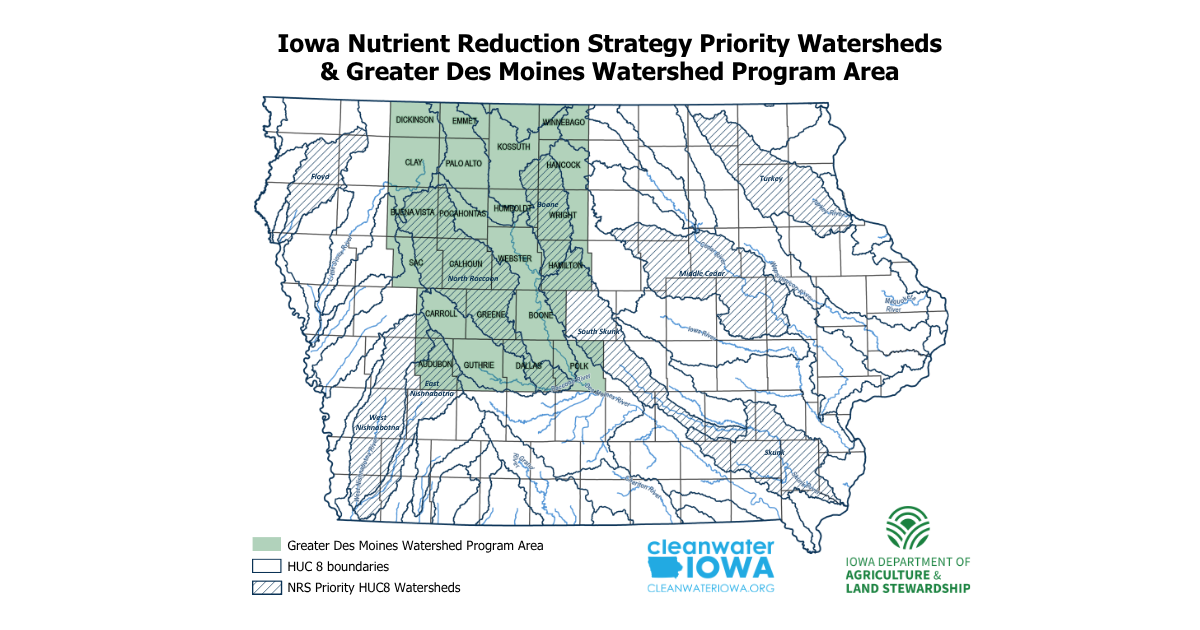
DES MOINES, Iowa (June 22, 2026) - Iowa Secretary of Agriculture Mike Naig today announced the launch of the Greater Des Moines Watershed Program, a targeted initiative to accelerate and scale up the use of conservation practices across 22 counties upstream from the Des Moines metro. The program was created as part of the Farm to Faucet water quality package signed into law by Gov. Kim Reynolds on June 1. It will support a series of conservation incentives, cost-share and targeted investments to improve water quality upstream and downstream.
The first phase of the program enhances cover crop incentives for farmers and landowners in the Greater Des Moines watershed, increasing cost-share payments for both new and existing cover crop users to $25 per acre and increasing the maximum eligible acreage to 500 acres per farmer or landowner. The Iowa Department of Agriculture and Land Stewardship is investing an additional $2.5 million in this program with the goal of doubling cover crop adoption across the watershed. Counties with the expanded cost-share include Audubon, Boone, Buena Vista, Calhoun, Carroll, Clay, Dallas, Dickinson, Emmet, Greene, Guthrie, Hamilton, Hancock, Humboldt, Kossuth, Palo Alto, Pocahontas, Polk, Sac, Webster, Winnebago and Wright.
Today's announcement is the first of several conservation initiatives that will be rolled out through the Greater Des Moines Watershed Program in the coming weeks.
“Improving water quality requires a system-wide approach from the farm to the faucet, and farmers continue to step up by implementing proven conservation practices on their farms. Cover crops are one of the most effective tools we have to keep soil and nutrients in the field, improve soil health, and protect water quality. That's why we're increasing incentives and making it easier for farmers and landowners to participate,” said Secretary Naig. “This is the first of several conservation investments that will be announced through the Greater Des Moines Watershed Program in the weeks ahead. These targeted conservation efforts upstream complement the infrastructure investments that are also being made downstream. Farmers and landowners can get signed up now by stopping in their USDA Service Center, or they can learn more at CleanWaterIowa.org.”
As part of the program, both new and existing cover crop users within the eligible counties may receive cost-share assistance of up to $25 per acre and enroll up to 500 acres. Cover crops are one of Iowa’s most effective conservation practices for improving water quality while also delivering agronomic benefits to farmers. They help reduce soil erosion, improve water infiltration, build soil organic matter, suppress weeds, provide livestock forage opportunities, and keep nutrients in the field and out of nearby waterways.
Implementing the Iowa Nutrient Reduction Strategy
Farmers are using proven conservation practices outlined in the Iowa Nutrient Reduction Strategy, including cover crops and wetlands, to prevent soil erosion, filter nitrates and improve water quality. It is part of their commitment to using responsible farming practices to benefit their communities and the environment. There’s more work to do but Iowa farmers are accelerating the pace at which they’re adopting conservation practices.
The State of Iowa invests nearly $100 million annually towards improving water quality, with an additional $500 million coming from the federal government each year.
In 2024, Iowa farmers planted nearly 4 million acres of cover crops, up from fewer than 400,000 just a decade ago. Farmers are also building more water quality wetlands, which capture water as it leaves the field, reducing nitrate runoff by up to 90 percent. Over 150 wetlands have been constructed statewide, and the pace is accelerating; nearly three times as many wetlands have been built in the past four years compared to the previous two decades.
In addition, farmers have installed nearly 500 nitrate-filtering buffers along field edges, all of which capture and treat water before it reaches streams, and these practices have been installed about five times faster in the past four years than in the previous decade.